

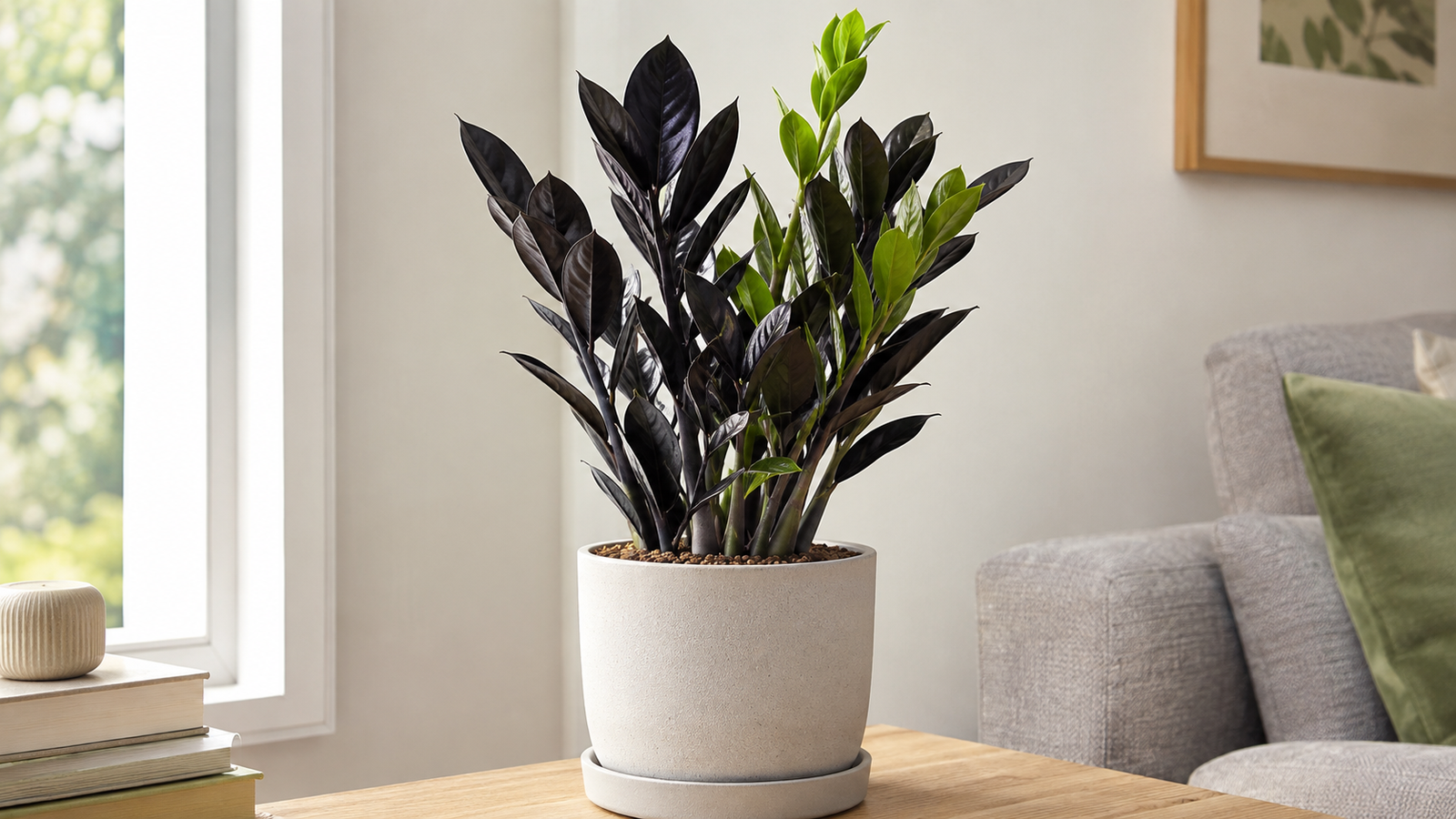

The Black Raven ZZ Plant is an easy-care houseplant known for its glossy foliage that changes from lime green to deep purple-black as the leaves mature. It has the same forgiving nature as the traditional ZZ plant, making it xa practical choice for busy homes and beginner plant owners.
The key to successful Black Raven ZZ Plant care is simple: give it suitable indirect light, use well-draining soil, and avoid watering too often. Because the plant stores water in underground rhizomes, it handles dry periods much better than consistently wet soil.
What Is a Black Raven ZZ Plant?
The Black Raven ZZ Plant is the cultivar Zamioculcas zamiifolia ‘Raven’, also sold under the name ‘Dowon’. It is a member of the Araceae family and is closely related to the classic green ZZ plant.
Its most noticeable feature is the foliage. New leaves emerge bright lime green and gradually become dark purple to almost black as they mature. The plant has upright, glossy leaf stems and thick, fleshy rhizomes beneath the soil that store water.
Raven ZZ is also a naturally slow-growing plant. That means you should not expect frequent new leaves or rapid growth, even when the plant is healthy. For a botanical overview, see the North Carolina State University Extension Raven ZZ profile.
Where Can You Buy a Black Raven ZZ Plant?
Thinking about adding a Raven ZZ to your home? Plant Addicts sells Black Raven ZZ plants in several container sizes, so you can compare the available options before choosing one for your space.
| Light | Low to bright, indirect light |
|---|---|
| Water | Let the soil dry out completely between waterings |
| Soil | Well-draining indoor potting mix |
| Humidity | Average household humidity is fine |
| Temperature | About 59–75°F (15–24°C) |
| Fertilizer | Light feeding during active growth |
| Repotting | Every 2–3 years, or when it outgrows the pot |
| Growth rate | Slow — expect only a few new stems a year |
How Much Light Does a Raven ZZ Plant Need?
A Raven ZZ Plant can tolerate a surprisingly wide range of indoor lighting, from low light to bright, indirect light. For the best balance of healthy growth and attractive foliage, bright filtered or indirect light is a good choice.
A spot near an east-facing window can work well. Near brighter south- or west-facing windows, keep the plant away from harsh afternoon rays or filter the sunlight with a sheer curtain.
Low light is tolerated, but very low light can slow growth. Too much direct sun can scorch or brown the leaves. The RHS specifically recommends filtered light and notes that excessive direct sunlight can damage the foliage.
One feature that makes Raven ZZ especially interesting is its changing leaf color. New growth starts green and gradually darkens as it matures.
How Often Should You Water a Raven ZZ Plant?
Water your Raven ZZ only after the potting mix has dried out completely.
Its underground rhizomes store water, which helps the plant tolerate periods of drought. That is why overwatering is generally a bigger concern than forgetting to water it occasionally.
When the soil is dry, water thoroughly until excess water drains from the bottom of the pot. Let the pot drain fully and do not leave the plant sitting in standing water.
Avoid following a rigid schedule such as “water every seven days.” The right frequency depends on light, temperature, pot size, soil, and the time of year.
During winter, the plant may need water much less frequently because growth slows and the soil takes longer to dry. North Carolina State University Extension notes that Raven ZZ can be watered much less often during winter than during active summer growth.
Signs You May Be Overwatering
Watch for:
- Yellowing leaves
- Soft or collapsing stems
- Soil that stays wet for a long time
- Root or rhizome problems
Signs of Underwatering
A severely dry plant may develop drooping or curling foliage, but always check the soil before watering. ZZ plants are naturally capable of going through dry periods, so occasional dryness is not necessarily a problem.
Best Soil for a Raven ZZ Plant
Raven ZZ needs soil that drains freely.
A quality indoor potting mix with added drainage material can help prevent the growing medium from staying wet for too long. The exact recipe matters less than good drainage and sensible watering.
Always use a container with drainage holes. A decorative pot without drainage can trap excess moisture around the rhizomes and roots.
Both the RHS and NC State recommend well-drained growing conditions for Raven ZZ.
Temperature and Humidity
Raven ZZ is comfortable in typical indoor conditions. The RHS recommends temperatures around 59–75°F (15–24°C). Protect the plant from extreme cold, cold drafts, and sudden temperature changes.
Keep it away from strong heating vents and air-conditioning outlets where possible.
Humidity is not something you need to overthink with this plant. Average household humidity is generally adequate. Unlike many tropical houseplants, Raven ZZ does not require a humidifier simply to stay healthy.
How to Fertilize a Raven ZZ Plant
Raven ZZ is a relatively light feeder.
During active growth, a balanced houseplant fertilizer can be used at a conservative rate. The RHS recommends feeding during the growing season at half the rate stated on the product label and reducing feeding during fall and winter.
Avoid the temptation to fertilize more often just because the plant is growing slowly. Slow growth is part of the plant’s natural habit, and excessive fertilizer can cause unnecessary stress.
Repotting a Raven ZZ Plant
You do not need to repot a Raven ZZ every year.
Wait until the plant has outgrown its container, become noticeably root-bound, or the potting mix has deteriorated and is no longer draining properly.
When repotting:
- Choose a container only slightly larger than the current pot.
- Make sure it has drainage holes.
- Use fresh, well-draining potting mix.
- Handle the roots and rhizomes carefully.
- Water appropriately after repotting without keeping the soil saturated.
The RHS recommends repotting only when necessary, typically every two to three years, and advises against moving a ZZ plant into a much larger container.
How to Prune a Raven ZZ Plant
Regular pruning is not necessary for a healthy Raven ZZ.
Pruning is mainly useful for removing yellow, dead, or damaged growth. Use clean, sharp pruning shears and cut unwanted stems close to the base.
There is no need to prune healthy stems simply to make the plant grow faster. Raven ZZ is naturally slow-growing, and aggressive pruning will not change that basic growth habit. The RHS recommends removing faded leaves as needed.
How to Propagate a Raven ZZ Plant
Raven ZZ can be propagated, but it requires patience. Division is generally the quickest and most practical method for an established plant, while leaf propagation takes considerably longer.
Propagation by Division
Division works best when the plant already has multiple stems and rhizomes.
- Remove the plant carefully from its pot.
- Gently loosen enough soil to see the roots and rhizomes.
- Separate a healthy section with attached roots and at least one stem.
- Pot the division in well-draining soil.
- Place it in bright, indirect light while it establishes.
Propagation From Leaf Cuttings
ZZ plants can also be propagated from individual leaflets.
Take a healthy leaflet with its petiole attached and place it in a clean propagation medium. Keep the medium lightly moist and provide bright, indirect light.
This is a slow process. Roots form first, followed by a small rhizome, and new growth can take months. University of Illinois Extension provides detailed guidance on both division and leaf propagation.
Common Raven ZZ Plant Problems
Yellow Leaves
One yellow leaf does not always indicate a serious problem. Older leaves can naturally age and yellow.
Several yellowing leaves, especially when the soil stays wet, can point to overwatering or poor drainage. Check the soil before adding more water.
Soft or Mushy Stems
Soft, collapsing stems are a warning sign. If the soil is staying wet for extended periods, excessive moisture may be contributing to root or rhizome problems.
Check the drainage and watering routine first.
Curling or Drooping Leaves
Curling or drooping can have several causes, including insufficient water, environmental stress, or unsuitable light and temperature conditions.
Check the soil moisture before deciding what action to take. A Raven ZZ should not be watered simply because its leaves look slightly different.
Brown Leaf Tips
Brown tips can result from environmental stress, inconsistent watering, or excessive direct sunlight.
Look at the plant’s recent conditions rather than treating brown tips as proof of one specific problem.
Slow Growth
Slow growth is normal for Raven ZZ.
Low light can make growth even slower, but increasing fertilizer or watering will not necessarily solve the problem. Give the plant appropriate indirect light and reasonable growing conditions, then be patient.
NC State University Extension describes Raven ZZ as a slow-growing, low-maintenance plant.
Pests
Raven ZZ is generally resistant to many pest problems, but occasional infestations can still happen.
Inspect the foliage and stems regularly for unusual spotting, sticky residue, or visible insects. NC State specifically notes scale insects as a pest to watch for, while University of Illinois Extension also lists common houseplant pests such as aphids, mealybugs, thrips, and whiteflies for ZZ plants generally.
How to Keep a Raven ZZ Plant Healthy
Good Raven ZZ care is mostly about avoiding extremes.
Remember these basics:
- Give it bright, indirect light when possible.
- Let the soil dry completely between waterings.
- Use a pot with drainage holes.
- Choose a well-draining potting mix.
- Protect it from extreme cold and drafts.
- Fertilize lightly during active growth.
- Expect slow growth.
The plant is much more likely to struggle from consistently wet soil than from being left dry for a little too long.
